I have used the Gaia synthesizer to create some sound effects for the beginning and end of the track. It takes the form of the alarm at the beginning of the track and the heartbeat monitor at the end. This serves as the second DI recording for my track. It was preferable to record this through DI because it records a pure, stable signal from the synthesizer, which is much easier to edit and arrange in Logic. Also, I didn't really have a choice to record the Gaia from anything other than DI, as it has no built in speakers and would be pointless to amp it up and record from a microphone. From my Mac workstation, it was easy to edit the parameters on the synth to get the sound I wanted without latency. Doing this in the studio would of been a hassle and waste of time and resources. My track arrangement finished and I have done my mixing. The final piece consists of 19 tracks and lasts for 4 minutes and 16 seconds. It includes the following instruments:
Piano
Tubular Bells
Various Orchestral Percussion (including Timpani)
Male and Female Choir
String Sections (Violin, Viola, Cello, Double Bass) utilising musical techniques Staccato and Tremolo
Trombones (also utilising Staccato)
Vocoded Vocals
Sound Effects made from a Gaia Synthesiser
Electric Guitar (Smothered in effects like Echo and Chorus)
At the end of my mixing process my financial record looks like this:
The Session Blog of Dan Burrows
Thursday, 22 May 2014
Wednesday, 14 May 2014
Evaluation of Monday 12th Session - Microphone Recording #2
Introduction
In the session we aimed to record two parts on the piano for my track. 8 Bars for the beginning on my track and another 40 bars for the middle of my track.
How effectively did the group work together?
The group worked very well together as always, just like in previous sessions. Communication was top notch and everybody knew what they were doing. The session started at 3:30 as planned and we had everything packed away by 5:00pm.
How effectively did the people involved in the session fulfil their role?
Performer/Producer (Myself): As a producer I believe I did well. Everybody knew what they were doing after I briefed them and they effectively carried out their roles to my requirements. As the performer, I recorded the first part of my piano piece in one take. On the other hand, I messed up multiple times when recording the second part of my piece. I eventually came to the conclusion that I was uncomfortable standing up and performing so I grabbed the nearby piano stool and sat on it.
Assistant - (Alex Dudley): Alex effectively played his role as assistant. During the setting up stage Alex set up the equipment quickly and in the correct places according to my set up plan. Alex was quick to suggest alternatives to me when we encountered a problem such as when the clips for one of the microphones was missing.
Assistant - (Mat Quinn): Alongside Alex, Mat performed equally well, setting up the equipment correctly and quickly according to the plan and correcting things when they went wrong, such as when a microphone was pointing away from the amp for some unknown reason (I'm assuming the back of the stand had been knocked slightly and it rotated away), Mat was quick to spot the problem and move the microphone to its correct position.
Engineer - (Alex Ross): Alex was an excellent engineer. He knew exactly what he was doing. When setting up he knew what tracks from when he was briefed (3 Mono and 1 Stereo). He gave me feedback through the microphone on the mixing desk and gave me plenty of heads up when we were about the start recording a take. He set the levels correctly and quickly and was clear when he needed me to play so he could do so.
Did you complete what you set out to complete?
We did indeed complete what we set out to do. We recorded both parts of the piano that I required and we finished and packed up within the planned time frame. I now have the piano pieces on my memory stick ready to be placed into my track. The session started at 3:30 as planned and we had everything packed away by 5:00pm. When setting up the overhead microphones, Alex Dudley suggested that we point the left overhead towards the cylindrical diffusers on the wall to get the most of the rooms ambience. The other overhead was positioned generally over the speaker to the right, pointing down at about a 70 degree angle towards the speaker. The SE 1A's that I ended up using were suitable for the job as they were condenser microphones operating in super cardioid (Requiring phantom power).
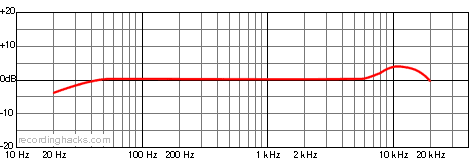
The above frequency response chart shows us that SE1A's have a very similar frequency response to the AKG C1000's (20 Hz to 20 KHz) to and were truly an excellent substitute. Taking into account that the SE1A's were designed for recording acoustic instruments (despite recording from an amp) I expected they would perform well.
Was health and safety met at all times?
Health and safety was met almost everywhere we could think of. All wires were trailed from behind the piano and away from where we needed to walk. No food or drink was present in the studio at any time and everybody acted responsibly and carefully with the equipment. The only thing I would of done differently was the piece of carpet that myself and the piano had to stand on. During performing I realised that the carpet was probably not the best place to set up the piano as I didn't want to run the risk of it sliding across the floor. I was extra careful not to shuffle my feet as to not move the carpet during recording, just in case. However the carpet didn't move due to the weight of the piano and myself. We made sure that phantom power was off and the gains were turned all the way down when plugging in and unplugging the microphones, this was to avoid loud pops and damage to the monitors.
What were the main strengths of the session?
The main strengths include the efficient carrying out of all tasks in the studio covering setting up, problem solving, the recording process and packing away. The session started and finished on time and my trust was well placed in my team members. The final result from the session was just as I hoped and I got all the audio files I needed.
What were the main weaknesses of the session?
A few problems were encountered during the session. For a start, one of the microphone clips were missing for the AKG C1000s and I couldn't use both. However Alex Dudley quickly suggested that I use the SE 1A's as overheads in their place, this leads to the second problem. We couldn't find another internal microphone clip adapter for while, although we did eventually find one. Upon arrival to the studio we found that there were multiple pieces of equipment still left out from the last group that were in there such as XLR cables left lying around in the live room and control room, a couple of percussion instruments in the control room including "shaky eggs" accompanied by a random bus ticket. It took us a few minutes to put these away before we could begin, although we just used some of the XLR leads since they were already there.
In the session we aimed to record two parts on the piano for my track. 8 Bars for the beginning on my track and another 40 bars for the middle of my track.
How effectively did the group work together?
The group worked very well together as always, just like in previous sessions. Communication was top notch and everybody knew what they were doing. The session started at 3:30 as planned and we had everything packed away by 5:00pm.
How effectively did the people involved in the session fulfil their role?
Performer/Producer (Myself): As a producer I believe I did well. Everybody knew what they were doing after I briefed them and they effectively carried out their roles to my requirements. As the performer, I recorded the first part of my piano piece in one take. On the other hand, I messed up multiple times when recording the second part of my piece. I eventually came to the conclusion that I was uncomfortable standing up and performing so I grabbed the nearby piano stool and sat on it.
Assistant - (Alex Dudley): Alex effectively played his role as assistant. During the setting up stage Alex set up the equipment quickly and in the correct places according to my set up plan. Alex was quick to suggest alternatives to me when we encountered a problem such as when the clips for one of the microphones was missing.
Assistant - (Mat Quinn): Alongside Alex, Mat performed equally well, setting up the equipment correctly and quickly according to the plan and correcting things when they went wrong, such as when a microphone was pointing away from the amp for some unknown reason (I'm assuming the back of the stand had been knocked slightly and it rotated away), Mat was quick to spot the problem and move the microphone to its correct position.
Engineer - (Alex Ross): Alex was an excellent engineer. He knew exactly what he was doing. When setting up he knew what tracks from when he was briefed (3 Mono and 1 Stereo). He gave me feedback through the microphone on the mixing desk and gave me plenty of heads up when we were about the start recording a take. He set the levels correctly and quickly and was clear when he needed me to play so he could do so.
Did you complete what you set out to complete?
We did indeed complete what we set out to do. We recorded both parts of the piano that I required and we finished and packed up within the planned time frame. I now have the piano pieces on my memory stick ready to be placed into my track. The session started at 3:30 as planned and we had everything packed away by 5:00pm. When setting up the overhead microphones, Alex Dudley suggested that we point the left overhead towards the cylindrical diffusers on the wall to get the most of the rooms ambience. The other overhead was positioned generally over the speaker to the right, pointing down at about a 70 degree angle towards the speaker. The SE 1A's that I ended up using were suitable for the job as they were condenser microphones operating in super cardioid (Requiring phantom power).
![]() |
| SE1A Frequency Response Chart |
Was health and safety met at all times?
Health and safety was met almost everywhere we could think of. All wires were trailed from behind the piano and away from where we needed to walk. No food or drink was present in the studio at any time and everybody acted responsibly and carefully with the equipment. The only thing I would of done differently was the piece of carpet that myself and the piano had to stand on. During performing I realised that the carpet was probably not the best place to set up the piano as I didn't want to run the risk of it sliding across the floor. I was extra careful not to shuffle my feet as to not move the carpet during recording, just in case. However the carpet didn't move due to the weight of the piano and myself. We made sure that phantom power was off and the gains were turned all the way down when plugging in and unplugging the microphones, this was to avoid loud pops and damage to the monitors.
What were the main strengths of the session?
The main strengths include the efficient carrying out of all tasks in the studio covering setting up, problem solving, the recording process and packing away. The session started and finished on time and my trust was well placed in my team members. The final result from the session was just as I hoped and I got all the audio files I needed.
What were the main weaknesses of the session?
A few problems were encountered during the session. For a start, one of the microphone clips were missing for the AKG C1000s and I couldn't use both. However Alex Dudley quickly suggested that I use the SE 1A's as overheads in their place, this leads to the second problem. We couldn't find another internal microphone clip adapter for while, although we did eventually find one. Upon arrival to the studio we found that there were multiple pieces of equipment still left out from the last group that were in there such as XLR cables left lying around in the live room and control room, a couple of percussion instruments in the control room including "shaky eggs" accompanied by a random bus ticket. It took us a few minutes to put these away before we could begin, although we just used some of the XLR leads since they were already there.
Monday, 12 May 2014
Monday 12th - My Session Plan for Microphone Recording #2
Session Plan for Monday 12th May
In this session I will be recording from the electric Yamaha piano. I chose this because I was originally going to record from the acoustic piano that is present in the live room but I didn't like its tonality. I will accomplish this by connecting the piano to an amp and recording from that using a SM57 dynamic microphone, which will be placed a bout 15cm away from the amp (pointing directly at it). I chose the SM57 because it has a high SPL (Sound Pressure Levels) and can cope with recording from an Amp at that distance.
From the above frequency response chart (with a response ranging from around 50 Hz to 20 KHz) we can see that it emulates the human ear in a way, perceiving higher frequencies louder than their physical volume. This way I can capture a realistic recording of the piano.
I will use two AKG C1000s overhead microphones and place them about 7 foot in the air above the speaker to capture the ambience of the room. These are suitable microphones as they are condenser microphones and can operate in super cardioid mode, allowing me to use them at a distance from the sound source.
As we can see by the above frequency response chart, the AKG C1000's are suitable for recording piano (with a response ranging from around 50 Hz to 20 KHz), capturing the broad range of frequencies of the piece, which starts on D3 and stretches up about 2 octaves, and ends with multiple low pitch D notes. I recognise this as an unusual method of recording from the electric piano as DI would have been a more preferable way. However to fill a grading criteria I required more audio to be recorded from a microphone. This will fulfil the grading criteria in which I have to record two sources with a microphone (alongside the vocals that we recorded in Mat Quinn’s session). The original plan was to use the actual piano in the live room but I much prefer the timbre and tonality of the Yamaha Electric piano. For this session I am going to need two studio assistants to help set up and maintain the equipment and an engineer to operate Pro Tools and the main desk. The session will commence at 3:30pm and is planned to end at 5:30pm.
From the above frequency response chart (with a response ranging from around 50 Hz to 20 KHz) we can see that it emulates the human ear in a way, perceiving higher frequencies louder than their physical volume. This way I can capture a realistic recording of the piano.
I will use two AKG C1000s overhead microphones and place them about 7 foot in the air above the speaker to capture the ambience of the room. These are suitable microphones as they are condenser microphones and can operate in super cardioid mode, allowing me to use them at a distance from the sound source.
![]() |
| Cardioid top, Hyper Cardioid bottom. |
Equipment List:
Yamaha Electric Piano
Marshall Amp
SM57 Microphone
SM58 Microphone (for Talkback)
AKG C1000s Microphone x2
XLR cable x4
Microphone Stand x4
Headphones
Jack adapter
Session Roles
Producer/Performer - Dan Burrows: In this session I will be producing and performing myself since it is for my track and I can play the part. I will need to coordinate my team correctly by briefing them on the plan and going over the equipment list/setup plan. I must then perform my part on the piano while it is recorded.
Assistant - Alex Dudley/Mat Quinn: Alex and Mat will be assisting me in my session by setting up the equipment after I have briefed them on the session plan. This will involve placing microphone and mic stands in the correct places according to the Setup Plan, maintaining the equipment should something go wrong or fall out of place as well as assisting the engineer.
Engineer - Alex Ross: I asked Alex Ross to be my engineer as he hasn’t been that role yet throughout the FMP. It will be his job to set the levels using the gain dials after the equipment is set up. He will also be responsible for operating Pro Tools while recording my piece and giving me feedback through talkback.
I/O Plan
SM57 - Analogue 1
SM58 - Analogue 4
AKG C1000s - 5-6 (Stereo channels)
Headphones - Headphone jack output 1
Setup Plan
Wednesday, 7 May 2014
7th May Alex Dudley's Session Recap
I arrived at the studio this morning at 9:00 am to once again play the role of studio assistant. We went to mic up the drum kit but suddenly realised that the snare drum was gone. Luckily there was a different one in the control room which we borrowed. Truth be told we all thought it sounded better than the one we normally use so it was a fortunate inconvenience.
EDIT: I have been informed that the snare drum we found WAS in fact the snare drum we normally used so I don't know what's going on with that.
We set up all the microphones on the drum kit and Dan A even found both the SM58's that have been missing for ever.
Alex D couldn't find his memory stick but then Alex R just randomly found it in Alex D's bag. We went to the LRC in order to download a backing track from our Google Drive folder, but that took about 10 minutes thanks to the computers being slow. When we got back downstairs we set the levels with no trouble.
In total we took three takes and all of them were very good. We took three just in for variety and because we had plenty of time. Surprisingly Pro Tools never even crashed once! The session had a bit of a manic start but in the end it turned out very well. Below is a video of the studio during a take recording.
Thursday, 1 May 2014
My FMP Track - DI Session #1
I thought it was about time to post an update on my personal track entitled "Crash Landing", the finale to our EP. I brought in my own guitar and jack lead today to record some of it and structure a new section of my song around it. Since I am bringing in my own equipment it shouldn't cost me anything on my finances. I recorded it through the Scarlet DI box on my Mac workstation in G039. I chose to record my guitar through DI rather than an amp and microphone because its a lot easier and I can use the amp modelling plugins in Logic, along with all of its effects on pedalboard. The amp modeller plugin allows me to directly intercept the signal from the guitar and alter the sound based on real life amplification cabinets. I then sent the signal from the amp modeller and through the pedalboard plugin which allowed me to add multiple effects such as fuzz, chorus and echo delay. If I was to record the guitar in the studio using a microphone I would of also captured the acoustics of the room/unwanted reverberation. Recording using DI allowed me to capture just the guitar, which is much easier to edit in Logic and add effects without unwanted side effects. Its also easier for me to record at my workstation using DI, as when I messed up I just stopped the recording and started again. Organising a studio session for just that guitar part would have been a waste of the recording budget. My track as of now clocks out at about 3 minutes and 50 seconds.
I'm using a chorus effect and echo delay alongside some slight fuzz to give a very ambient guitar effect to go with the string staccato's and piano. Only things left on the checklist now is; book some studio time to record the piano, DI either a bass guitar or the Gaia synth (haven't decided yet which one I want) and arrange the ship announcer vocals.
![]() |
| My session view with the pedalboard view |
Wednesday 30th April - Dan Allen's Session
Studio assistant, again! Not that it's a bad thing, I enjoy being the assistant/photo guy. Anyway in this session we were recording...you guessed it, more drums performed by Mr Alex Ross himself! The role of studio engineer was filled by Alex Dudley while Dan Allen, the organiser of the session, was the producer. This session went pretty well, I think Pro Tools only crashed twice as opposed to the four or five times it crashed during our second recording session. We set up the drum kit and microphones with no trouble as usual, but while setting the levels we had a bit of a rogue floor tom issue where we couldn't seem to set it to an appropriate level. We resolved it within about 3 minutes though, we just had to keep adjusting the levels until it settled.
It took numerous takes until we had the perfect one, but that's perfectly acceptable since Alex Ross only had one day to practice the piece. Overall the session went very well and we accomplished everything we set out do.
![]() |
| Dr Ross in action |
![]() |
| Session Success |
Monday 28th April 2014 Alex Ross' Recording Session / Microphone Recording Session #1
This session started at 12:00 and we finished at about 14:30. I was an assistant alongside Alex Dudley, with Mat Quinn engineering and Alex Ross performing/producing. After we had set up our microphones on the drum kit and set levels we encountered our first problem, Pro Tools crashed before we were about to save, so we had to set all the levels again. After we did this, we did our first take and it went very well with no mistakes (one take Ross is back!). We did another take just in case but Pro Tools froze and then crashed again at the end of the recording. Luckily we saved after the first take and decided to use that since it was a great take.
Afterwards we set up the SE2200 so we could record some vocals/dialogue ready to be vocoded for our space ship announcer. We all took turns reading some lines from a quickly put together script and ended up recording some pretty funny mess-ups for the blooper reel. We did however manage to record our lines despite Pro Tools crashing again somewhere in-between. The samples are being shared throughout the group for use in all of our tracks.
![]() |
| Vocal Session View |
![]() |
| Drums Session View |
Afterwards we set up the SE2200 so we could record some vocals/dialogue ready to be vocoded for our space ship announcer. We all took turns reading some lines from a quickly put together script and ended up recording some pretty funny mess-ups for the blooper reel. We did however manage to record our lines despite Pro Tools crashing again somewhere in-between. The samples are being shared throughout the group for use in all of our tracks.
Tuesday, 29 April 2014
9th April 2014 Mat Quinn's Session
In this session I played the role of assistant for Mat Quinn while he performed and recorded a piece on the acoustic guitar for his track. As usual our group worked very well together, we set up the microphones and Pro Tools session and prepared to record. We used 2 SM57's for the guitar and a SM58 for talkback.
![]() |
| Mat settling in to record his part. |
This is when we encountered a couple of problems. We had to deal with a faulty XLR cable, but this was easy enough because we only needed to replace it. Then something strange happened with the input gain while trying to set the levels on the desk. It was really quiet for some reason and the input gain on the first channel was acting weird and we had heard some crackling while adjusting it. We tried turning up the master signal gain and that helped us enough for us to record the piece.
![]() |
| Our Analogue Input setup |
![]() |
| #Nailed It |
Tuesday, 8 April 2014
It Begins / My FMP Track Update #1
It starts as an 'epic' styled orchestral piece, using the musical tones of stringed instruments and orchestral percussion (timpani etc.). I intend on transitioning my piece into a metal style, utilising electric guitars and a different drum kit. From there I want to transition it into an electronic style but still keeping elements from the two previous styles (I only plan to create the electronic bit if I have time to spare). I am using Logic 10 to create the orchestral parts and to record guitar. I plan on using Reason 7 to create the electronic part as I am more familiar with its synthesizers and instruments.
So far I have played the role of studio engineer in a recording session for Mathew Quinn. Alex Ross performed drums for Mat's piece on the V-Drums. The original plan was to use the standard acoustic drum kit, but there were complications due to the chain on the hi-hat being broken. During my role I operated Logic 10 on the MacBook and we got the recording done on time.
Subscribe to:
Posts (Atom)


