In the session we aimed to record two parts on the piano for my track. 8 Bars for the beginning on my track and another 40 bars for the middle of my track.
How effectively did the group work together?
The group worked very well together as always, just like in previous sessions. Communication was top notch and everybody knew what they were doing. The session started at 3:30 as planned and we had everything packed away by 5:00pm.
How effectively did the people involved in the session fulfil their role?
Performer/Producer (Myself): As a producer I believe I did well. Everybody knew what they were doing after I briefed them and they effectively carried out their roles to my requirements. As the performer, I recorded the first part of my piano piece in one take. On the other hand, I messed up multiple times when recording the second part of my piece. I eventually came to the conclusion that I was uncomfortable standing up and performing so I grabbed the nearby piano stool and sat on it.
Assistant - (Alex Dudley): Alex effectively played his role as assistant. During the setting up stage Alex set up the equipment quickly and in the correct places according to my set up plan. Alex was quick to suggest alternatives to me when we encountered a problem such as when the clips for one of the microphones was missing.
Assistant - (Mat Quinn): Alongside Alex, Mat performed equally well, setting up the equipment correctly and quickly according to the plan and correcting things when they went wrong, such as when a microphone was pointing away from the amp for some unknown reason (I'm assuming the back of the stand had been knocked slightly and it rotated away), Mat was quick to spot the problem and move the microphone to its correct position.
Engineer - (Alex Ross): Alex was an excellent engineer. He knew exactly what he was doing. When setting up he knew what tracks from when he was briefed (3 Mono and 1 Stereo). He gave me feedback through the microphone on the mixing desk and gave me plenty of heads up when we were about the start recording a take. He set the levels correctly and quickly and was clear when he needed me to play so he could do so.
Did you complete what you set out to complete?
We did indeed complete what we set out to do. We recorded both parts of the piano that I required and we finished and packed up within the planned time frame. I now have the piano pieces on my memory stick ready to be placed into my track. The session started at 3:30 as planned and we had everything packed away by 5:00pm. When setting up the overhead microphones, Alex Dudley suggested that we point the left overhead towards the cylindrical diffusers on the wall to get the most of the rooms ambience. The other overhead was positioned generally over the speaker to the right, pointing down at about a 70 degree angle towards the speaker. The SE 1A's that I ended up using were suitable for the job as they were condenser microphones operating in super cardioid (Requiring phantom power).
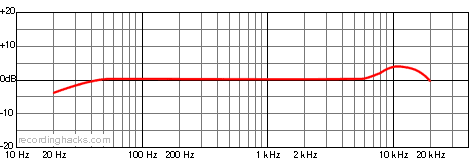 |
| SE1A Frequency Response Chart |

Was health and safety met at all times?
Health and safety was met almost everywhere we could think of. All wires were trailed from behind the piano and away from where we needed to walk. No food or drink was present in the studio at any time and everybody acted responsibly and carefully with the equipment. The only thing I would of done differently was the piece of carpet that myself and the piano had to stand on. During performing I realised that the carpet was probably not the best place to set up the piano as I didn't want to run the risk of it sliding across the floor. I was extra careful not to shuffle my feet as to not move the carpet during recording, just in case. However the carpet didn't move due to the weight of the piano and myself. We made sure that phantom power was off and the gains were turned all the way down when plugging in and unplugging the microphones, this was to avoid loud pops and damage to the monitors.
What were the main strengths of the session?
The main strengths include the efficient carrying out of all tasks in the studio covering setting up, problem solving, the recording process and packing away. The session started and finished on time and my trust was well placed in my team members. The final result from the session was just as I hoped and I got all the audio files I needed.
What were the main weaknesses of the session?
A few problems were encountered during the session. For a start, one of the microphone clips were missing for the AKG C1000s and I couldn't use both. However Alex Dudley quickly suggested that I use the SE 1A's as overheads in their place, this leads to the second problem. We couldn't find another internal microphone clip adapter for while, although we did eventually find one. Upon arrival to the studio we found that there were multiple pieces of equipment still left out from the last group that were in there such as XLR cables left lying around in the live room and control room, a couple of percussion instruments in the control room including "shaky eggs" accompanied by a random bus ticket. It took us a few minutes to put these away before we could begin, although we just used some of the XLR leads since they were already there.
